Understanding the 4th Amendment
📅 2026 Update: Recent Developments in the Amendment Process
Since the original article was published, there have been no new amendments to the U.S. Constitution. The most recent amendment remains the Twenty-Seventh Amendment, ratified in 1992.
This update will summarize the relevant changes and current facts about the amendment process. Readers can find the original article further down the page for more in-depth information.
🏛️ Proposal and Ratification Stages
The amendment process remains defined by Article V of the U.S. Constitution. An amendment can still be proposed by a two-thirds majority vote in both the House of Representatives and the Senate.
After proposal, it must be ratified by three-fourths of the state legislatures or by conventions in three-fourths of the states.
- 📜 Eligibility to Propose: Any member of Congress can propose an amendment. Alternatively, two-thirds of state legislatures can request a national convention to propose amendments, although this method has never been used.
⏳ Processing and Timeframes
The time it takes to ratify an amendment varies widely. Some amendments have been ratified in a few months, while others, like the Twenty-Seventh Amendment, took over 200 years to ratify.
- ⏰ Modern Deadlines: While the Constitution does not set a time limit for ratification, many modern proposals often include a seven-year deadline.
📚 Current Amendment Status
As of October 2026, there are still 27 amendments to the U.S. Constitution. Six proposed amendments have been sent to the states but have not received the required ratification.
- 🏛️ Historical Context: The Bill of Rights, the first ten amendments, was ratified in 1791 to gain support for the new Constitution.
💸 Costs Involved
There are no fees for citizens involved in the constitutional amendment process. Costs are generally handled by the government during the stages of proposal and ratification.
📌 Key Points Summary
- 🏛️ Amendments require a two-thirds vote in Congress and ratification by three-fourths of states.
- ⏳ Ratification timeframes can vary significantly.
- 📚 The most recent amendment is the Twenty-Seventh, ratified in 1992.
- 💸 No fees are charged to citizens during the amendment process.
💡 Tips for Understanding the Amendment Process
Review the details of your own situation with your attorney.
📜 Know the Proposal Methods
Understand that amendments can be proposed through Congress or by a national convention called by state legislatures. The congressional route is the only one used so far.
⏰ Be Aware of Timeframes
Recognize that ratification can take a long time. Some amendments may be passed quickly, while others could take years or even centuries.
💡 Understand Ratification Requirements
Remember that an amendment must be ratified by three-fourths of the state legislatures. This means that a significant consensus among states is needed for an amendment to become part of the Constitution.
🏛️ Study Historical Amendments
Look into historical amendments for context. The first ten amendments, or the Bill of Rights, were ratified in 1791 to ensure support for the Constitution.
📚 Explore Unratified Amendments
Be aware that several proposed amendments have been sent to the states but never ratified. Six amendments remain in this status, showing how challenging the amendment process can be.
🏆 Free Options Ranked by User Reviews (2026)
No national paid service qualified for this topic based on user reviews, so this section lists free government and nonprofit resources that provide information about the amendment process.
🥇 1. National Archives and Records Administration (NARA)
NARA offers detailed information and guidance on the amendment process. They help citizens understand how amendments are proposed and ratified.
🥈 2. U.S. Congress Website
The U.S. Congress website provides resources about current and past amendments, including their proposals and statuses. Citizens can access historical data and understand legislative processes.
🥉 3. State Legislative Websites
Each state has its own legislative website that provides information on state-level amendments. These sites can help citizens learn about local constitutional processes.
4️⃣ Local Libraries
Local libraries often have resources and staff that can assist with understanding the Constitution and its amendments. They may provide books, pamphlets, and workshops.
🔎 What to Check Before Paying for Help
- 🔍 Verify if the service is legitimate and recognized.
- 📜 Check for user reviews and ratings.
- 💰 Make sure there are no hidden fees before starting.
- 🏛️ Ensure the service provides clear information on the amendment process.
❓ Frequently Asked Questions
❓ What is the process for amending the Constitution?
The process involves proposing an amendment by a two-thirds majority in both the House and Senate. Then, it must be ratified by three-fourths of state legislatures.
❓ How long does it take to ratify an amendment?
Ratification times can vary greatly. Some amendments are ratified in a matter of months, while others, like the Twenty-Seventh Amendment, may take centuries.
❓ Can citizens propose amendments directly?
While citizens cannot propose amendments directly, two-thirds of state legislatures can call for a national convention to propose amendments. This method has never been used.
❓ What happens to unratified amendments?
Unratified amendments remain proposed but do not become part of the Constitution. They are often archived and may be revisited in the future.
❓ Are there any fees for the amendment process?
No, there are no fees for citizens involved in the amendment process. Costs are generally borne by the government.
❓ How many amendments have been proposed since the Constitution was established?
Since 1789, Congress has considered over 11,000 proposed amendments. However, only 33 have been sent to the states for ratification.
⚖️ Recent Cases Related to the 4th Amendment
There have been recent court rulings that impact how the Fourth Amendment is interpreted. These rulings continue to shape citizens' rights against unreasonable searches and seizures.
- Supreme Court dismisses Alabama death penalty caseSupreme Court of the United States · May 21, 2026
- Utah Supreme Court clarifies parental rights termination rulesUtah Supreme Court · July 29, 2026
- New Mexico Supreme Court Rules on Speedy Trial Rights CaseNew Mexico Supreme Court · July 8, 2026
- New Jersey Supreme Court rules on consumer debt rightsSupreme Court of New Jersey · July 8, 2026
For more recent rulings, you can browse more rulings on the news page.
End of October 2026 Update
Introduction: Understanding the Fourth Amendment
The Fourth Amendment is one of the most crucial amendments of the United States Constitution. It lays out the fundamental rights of American citizens, specifically protecting them from unreasonable searches and seizures by the government. This article outlines the history, text, purpose, and impact of the Fourth Amendment.
The Text of the Fourth Amendment
The Fourth Amendment reads as follows: "The right of the people to be secure in their persons, houses, papers, and effects, against unreasonable searches and seizures, shall not be violated, and no Warrants shall issue, but upon probable cause, supported by Oath or affirmation, and particularly describing the place to be searched, and the persons or things to be seized."
Historical Context of the Fourth Amendment
The Fourth Amendment was added to the Bill of Rights to ensure protection for American citizens against unwarranted searches and seizures since the British Government's power abuse on the American colonists. It aimed to prevent such governmental abuses by limiting the state's power to search and seize property without a warrant.
Probable Cause and Warrants
The Fourth Amendment requires that the government obtain a warrant before conducting a search or seizing property. This warrant must be issued by a judge and specifies the location to be searched and the items to be seized. Moreover, the government must have a reasonable suspicion that a crime has been committed and the search will provide evidence for that crime. The concept of probable cause helps to ensure that individuals' privacy is not breached without legitimate reason.
The Impact of Mapp v. Ohio
One of the most famous cases regarding the Fourth Amendment is Mapp v. Ohio, implying that evidence obtained during an illegal search could not be used in court. This Supreme Court decision firmly established the Fourth Amendment's significance in protecting personal privacy and civil liberties against the Government intervention.
Influence on American Law and History
The Fourth Amendment has played an important role in shaping the American legal system and influenced various state laws and regulations. It does not only protect individuals' rights against search and seizure by the government, but it has also covered the privacy protection in electronic communication. Its stricter understanding in some states such as California has also influenced the country's political and social history.
Differences from Other Countries
The Fourth Amendment provides a vital protection for individual freedom in American society, and it sets the USA apart from other countries that have different rules and regulations for search and seizure.
Importance of the Fourth Amendment in American Society
The Fourth Amendment is an essential safeguard of personal privacy and freedom from government intrusion. It continues to play a vital role in shaping the country's future by balancing citizen's privacy concerns against the state's need for investigation and safety.
Conclusion: The Fourth Amendment is an essential protection
In conclusion, the Fourth Amendment with its historical context, text, probable cause, warrants, Mapp v. Ohio, influences on American law and history, differences from other countries, importance in American society makes it one of the most important provisions in the Constitution. It plays a crucial role in protecting individual liberties and balancing that protection against state interests.
Included in the bill of Rights, the Fourth Amendment is a form of protection to individuals or citizens of the United States from unfair or unlawful treatment by law enforcement authorities. Even though its adoption has its roots in English law, it is undoubtedly included in the Constitution as the 4th Amendment due to questionable or unlawful treatment of citizens by the British military in the Thirteen Colonies.
The Fourth Amendment protects American citizens from a search and/or seizure conducted without reasonable doubt. The Fourth Amendment also extends further protection by requiring that warrants be issued and sanctioned by law in order to conduct a search and seizure. Furthermore, a warrant will only be issued if the probable cause can be proven.
The 4th Amendment provides for extra requirements and protection of citizens due to the abuse of the writ of assistance during the American Colonial Period. The writ of assistance was a type of general search warrant that was employed by tax collectors to search the homes of the colonists and seize goods, which was commonly abused and the collectors would often just seize what they wanted.
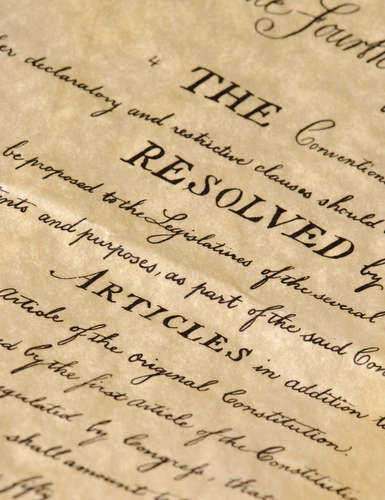
The common abuse of the writ of assistance led way to much dispute by the colonists and the matter was brought to court. Suffice it to say, the courts ruled against the colonists and their denouncing of the writ of assistance. John Adams, a historical American figure and President, would term the proceedings and occurrences during the court hearings as the "spark" for the American Revolution.
The Fourth Amendment is written into the Constitution as follows: "The right of the people to be secure in their persons, houses, papers, and effects against unreasonable searches and seizures, shall not be violated, and no Warrants shall issue, but upon probable cause, supported by Oath or affirmation, and particularly describing the place to be searched, and the persons or things to be seized." The 4th Amendment, at its most basic application, can be deemed as protection of private property and privacy. These inherent civil and human rights are not to be violated or infringed upon unless it is necessary under the law with just cause.Typically, a search and seizure are to be conducted by a member of law enforcement. In order to engage in such activities, a law enforcement officer must first secure a warrant, which is to be judicially sanctioned and considered as reasonable. An officer will be sworn under oath to the warrant and will often support the necessity for a warrant by probable cause.
Under the 4th Amendment, searches and seizures apply to governmental factions, but not those carried out by citizens or organizations with no ties to the Government itself. Originally, the Fourth Amendment was to apply only to the Federal Government, but a Supreme Court case held that it is also applicable to State governments under the Due Process Clause of the Fourteenth Amendment.
Furthermore, the 4th Amendment is only subject to matters of criminal law, and not those of civil law. The Fourth Amendment still proves to have importance today, for it still protects citizens from any law enforcement authority from overstepping its boundaries and violating civil rights granted by the Constitution.